
Maritime data without the silos — from operations to compliance
RedGet is a maritime data management platform for ports and terminals. Modular products for emission compliance, port operations, and data infrastructure — built on one unified data layer.
Ports run on data they can't reach
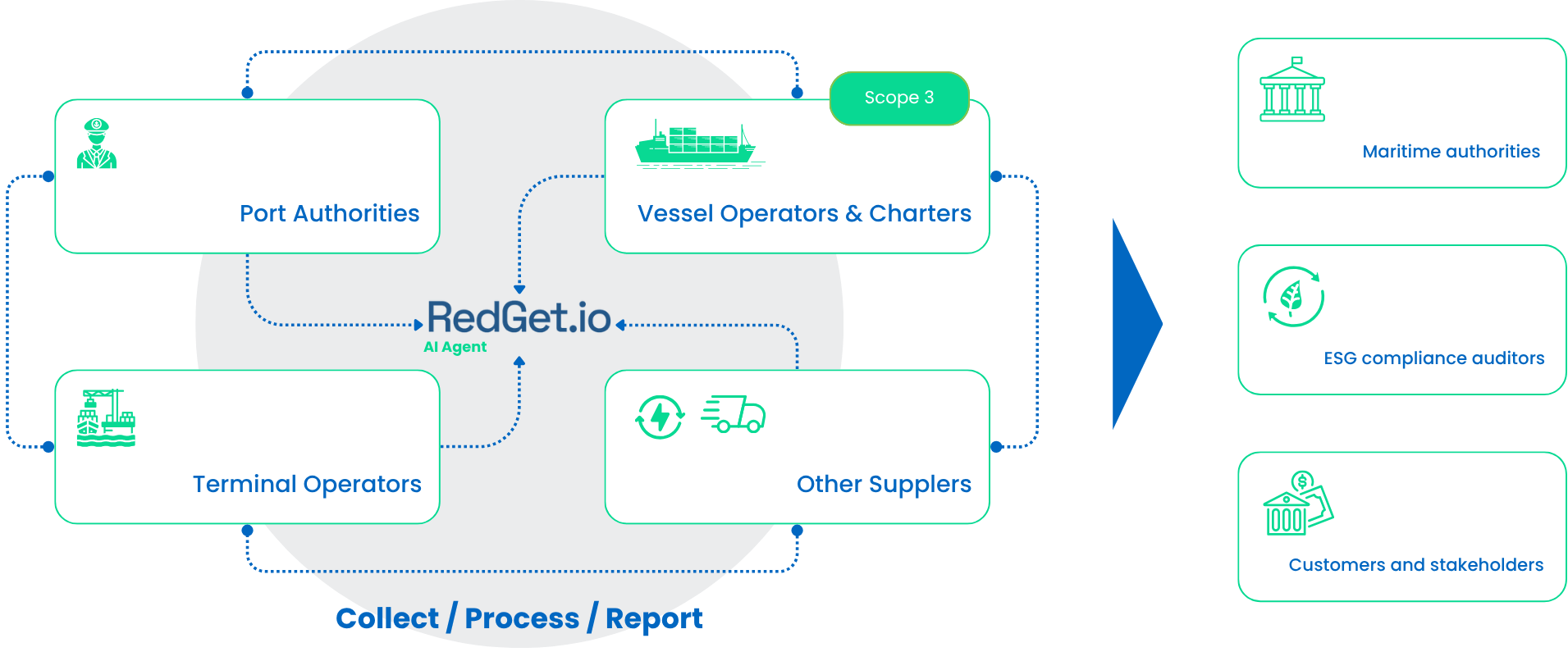
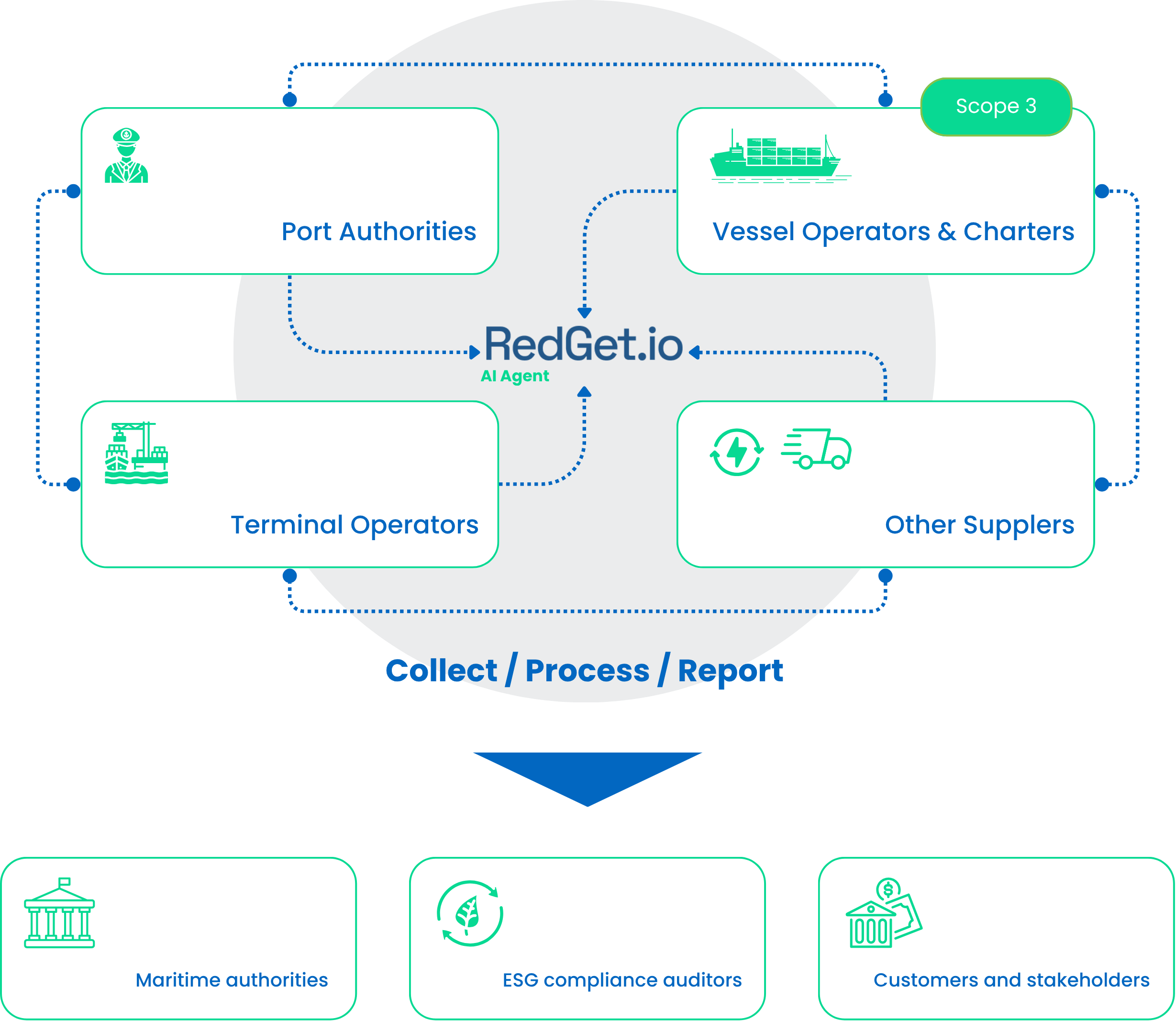
A port authority’s data sits in a Port Community System, a Terminal Operating System, VTS feeds, terminal spreadsheets, and consultant reports commissioned every three to five years. None of it reconciles. Departments answer the same question with different numbers.
The consequence shows up everywhere: emission figures that can’t be audited, berth performance nobody can measure, infrastructure investment decisions made on assumptions, and regulatory reporting assembled by hand under deadline.
The problem isn’t a missing report. It’s a missing data layer.
No hardware. No shipping company cooperation. No IT project.
1. We start with data you already have — or don’t need to collect.
Vessel emissions are derived from AIS. No sensors, no onboard telemetry, no cooperation from shipping lines. Scope 1 and 2 data is entered by your terminals and suppliers directly.
2. We normalise it.
Declared and derived data are kept separate and auditable. Every figure carries its methodology version and an append-only change record.
3. You report, plan, and act on it.
Continuous rather than triennial. Comparable year over year, because the method doesn’t change between vendors.
One data layer. Modular products on top.
RedGet normalises maritime data from AIS, port systems, and tenant submissions into a single structured layer — then delivers modular products that read from it. Adopt the module that solves your immediate problem. Activate the others when you’re ready. The data underneath is the same.
The First Maritime Sustainability AI Assistant - by RedGet.io. Free Early Access Today.
Built for ports & terminals, vessel operators, and sustainability consultants — powered by open trusted data and aligned with global compliance frameworks. Save hours on emissions reporting now!
Three domains, one platform

Emission Compliance
Automated vessel Scope 3 monitoring from AIS. Self-service Scope 1 & 2 reporting for the port and its terminals. Output aligned to CSRD/ESRS E1, EcoPorts SDM, GHG Protocol and GLEC.
Best fit for: environmental and sustainability teams

Port & Terminal Operations
Berth performance, vessel dwell time, maneuvering patterns and arrival forecasting — derived from the same data that drives your compliance reporting.
Best fit for: operations and port directors

Maritime Data Management
A maritime data lake with standardisation and deduplication across PCS, TOS, VTS and ERP systems. Client-restricted or RedGet-hosted.
Best fit for: CIOs and digital transformation leads
On the roadmap: port logistics and supply chain intelligence, maritime ESG data products for banks and insurers, and AIS-based safety and anomaly detection.
Built for the people who own the data problem:
Port authorities
Consolidate data across departments and tenants. Report once, from a source everyone agrees on.
Terminal operators
Report emissions to your port without rebuilding your spreadsheets. Measure berth and turnaround performance.
Vessel and ferry operators
Fleet-level Scope 3 monitoring and voyage data unified with port call records.
Why ports choose RedGet
Method you can defend
EMEP/EEA Tier 3 calculation engine, reported in line with ISO 14083:2023, using IMO MEPC.364(79)/MEPC.391(81) emission factors and IPCC AR5 GWPs. Assumptions, caps and exclusions are documented and published.
Built for multi-tenant ports
Most port data fragmentation isn’t inside the authority — it’s between the authority and its terminals, concessionaires and suppliers. RedGet is built around that boundary.
Continuous, not triennial.
Replace the periodic consultant inventory with a system that produces the same figures every day.
Deployment services included
Government and enterprise environments need configuration and integration, not a login. We deliver both.
Our Mission
Democratizing emissions reporting and enabling decarbonization for ports of all sizes - whether voluntary or by regulation.
Driving Impact in the Maritime Industry and Blue Economy — Aligned with the UN Sustainable Development Goals.

Start with one module. Not a transformation programme.
Tell us which data problem is costing you the most right now. We’ll show you the module that addresses it and what a deployment actually looks like.